
MENDAX — a whole-class bluffing review game for the classroom projector

MENDAX (Latin for liar) is a free whole-class review game from The Pericles Group Foundation, a 501(c)(3) nonprofit. It is the projector edition of Bluff, a review game that language teachers have passed around for years. Two teams, one question at a time, and one rule that changes everything: anyone can stand up and claim to know the answer, whether they do or not.
Everything happens on one screen that the teacher runs. Students don't need phones, laptops, or accounts, just a chair to stand up from.
MENDAX works in any class that has questions with right answers. The name is Latin and the sample pack is Latin, but the game works just as well for Spanish, French, Chinese, or any other language, and for science, history, math, or any other subject. If you can ask it, your students can bluff about it.
How to Play
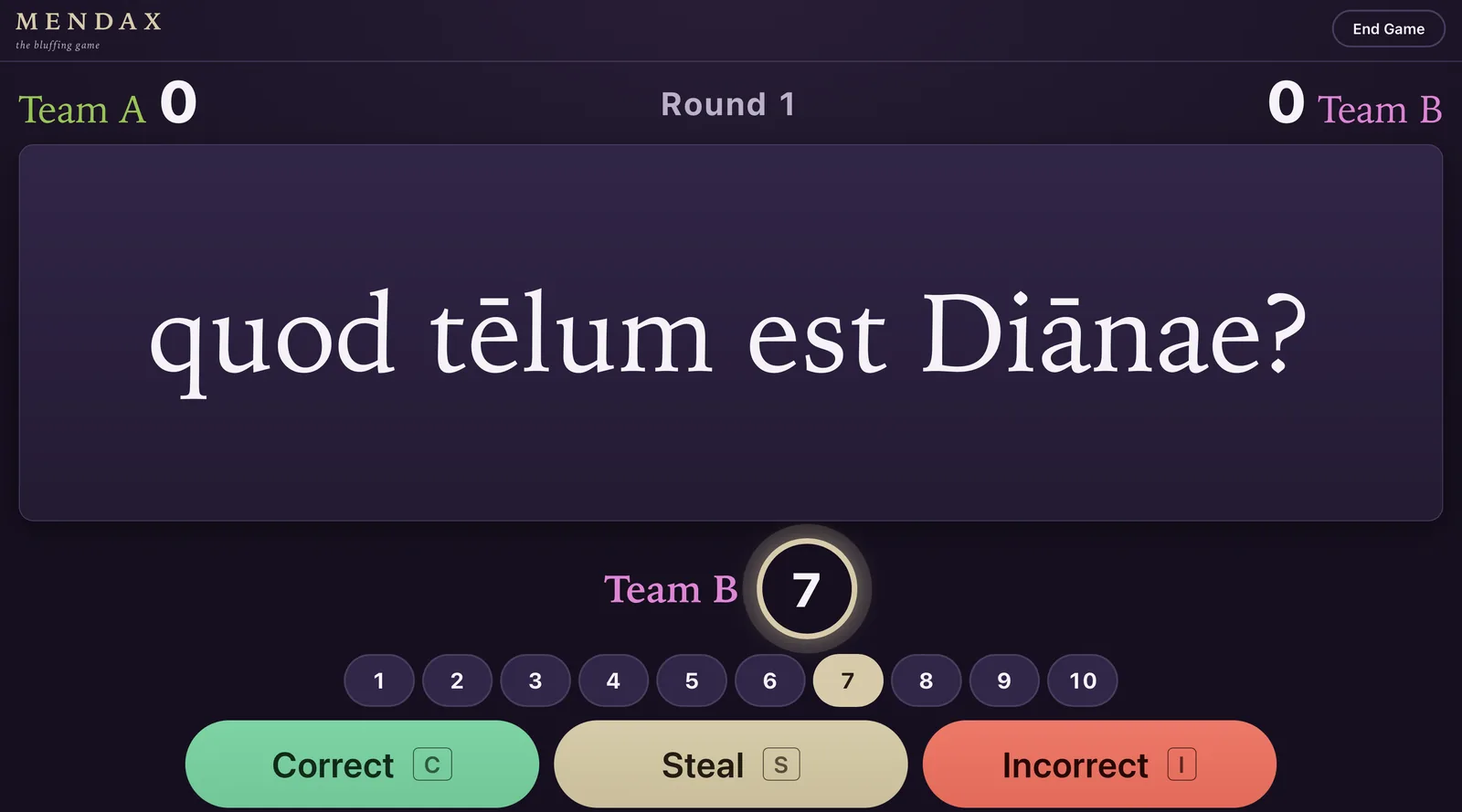
- Split the class into two teams. The screen shows a question to Team A.
- Everyone on Team A who thinks they can answer stands up. Bluffing is allowed, and expected.
- A student on Team B looks over the people standing and picks the one they suspect is bluffing.
- That student answers.
- Correct: Team A scores one point for every student who stood.
- Wrong: Team A loses points (none, half, or all of them, the teacher's choice), and Team B may steal for the full value.
- Teams swap. Repeat until the clock, the points target, or the questions run out.
More people standing means a bigger prize and a bigger risk. The quiet student who knows the answer, the confident one who doesn't, and the Team B student trying to read the room are what make it fun.
Running It on the Screen
MENDAX keeps the question deck, the standing count, the arithmetic, and the clock. You still ask, judge, and read the room.
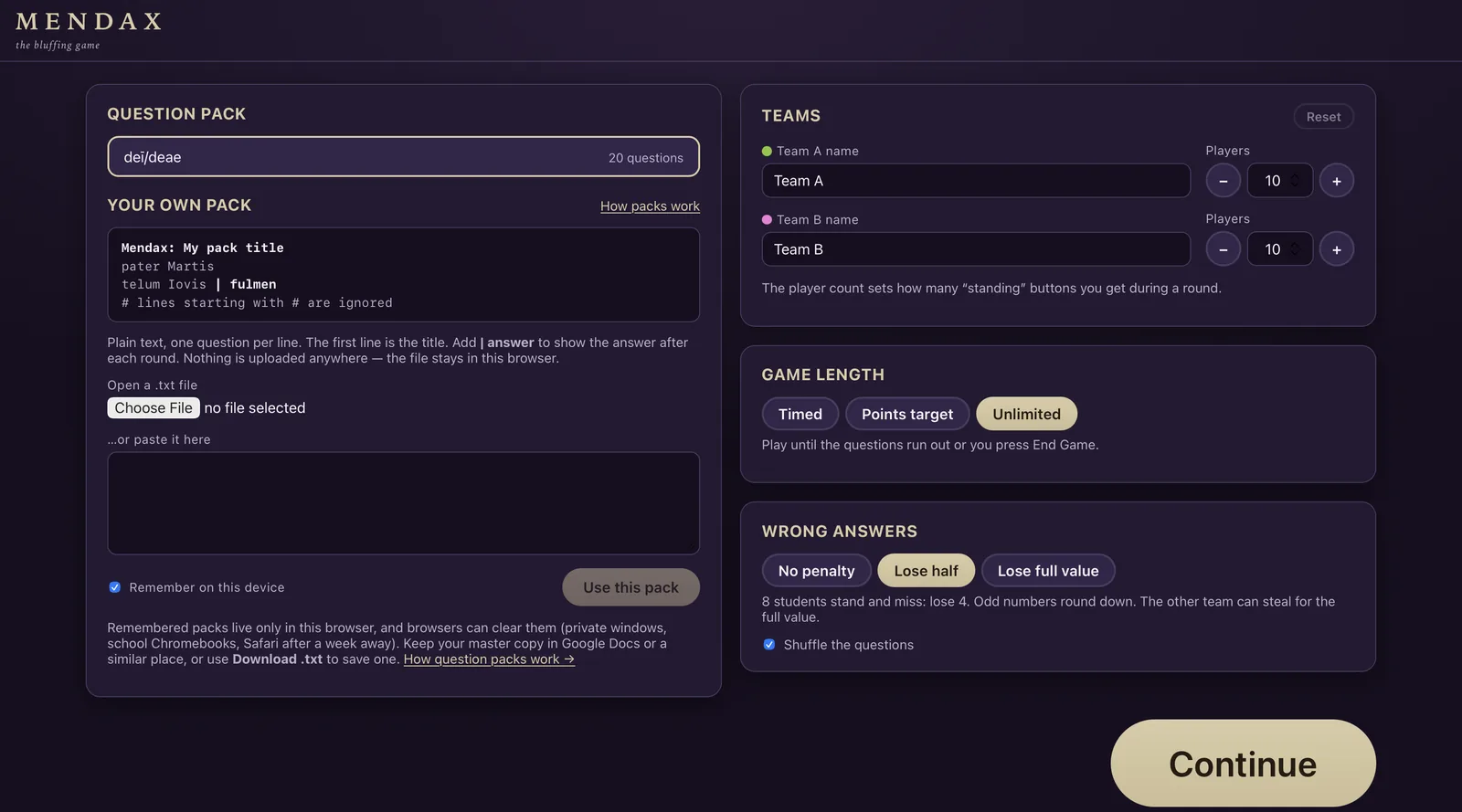
- Setup. Choose a question pack, name the teams, set how many players are on each side, and pick a game length (timed, first to a points target, or unlimited) and a wrong-answer penalty.
- Start. The screen draws which team goes first.
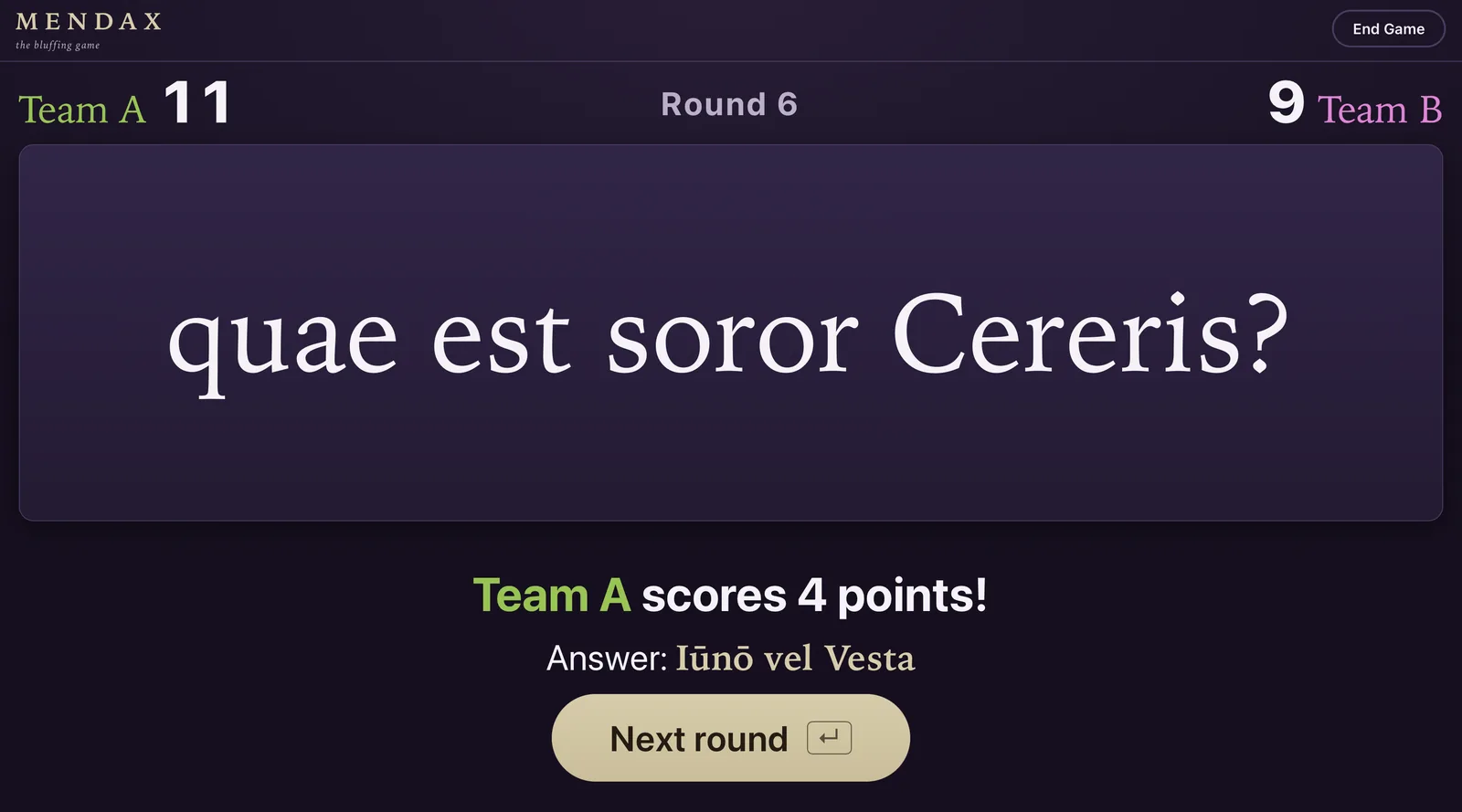
- Each round. Read the question aloud, count who's standing, tap that number, then tap Correct, Steal, or Incorrect. The score updates and, if your pack includes one, the answer appears.
- Keyboard friendly. Number keys set the standing count, C / S / I record the outcome, and Enter moves to the next round, so you can run the whole game from a wireless keyboard or clicker.
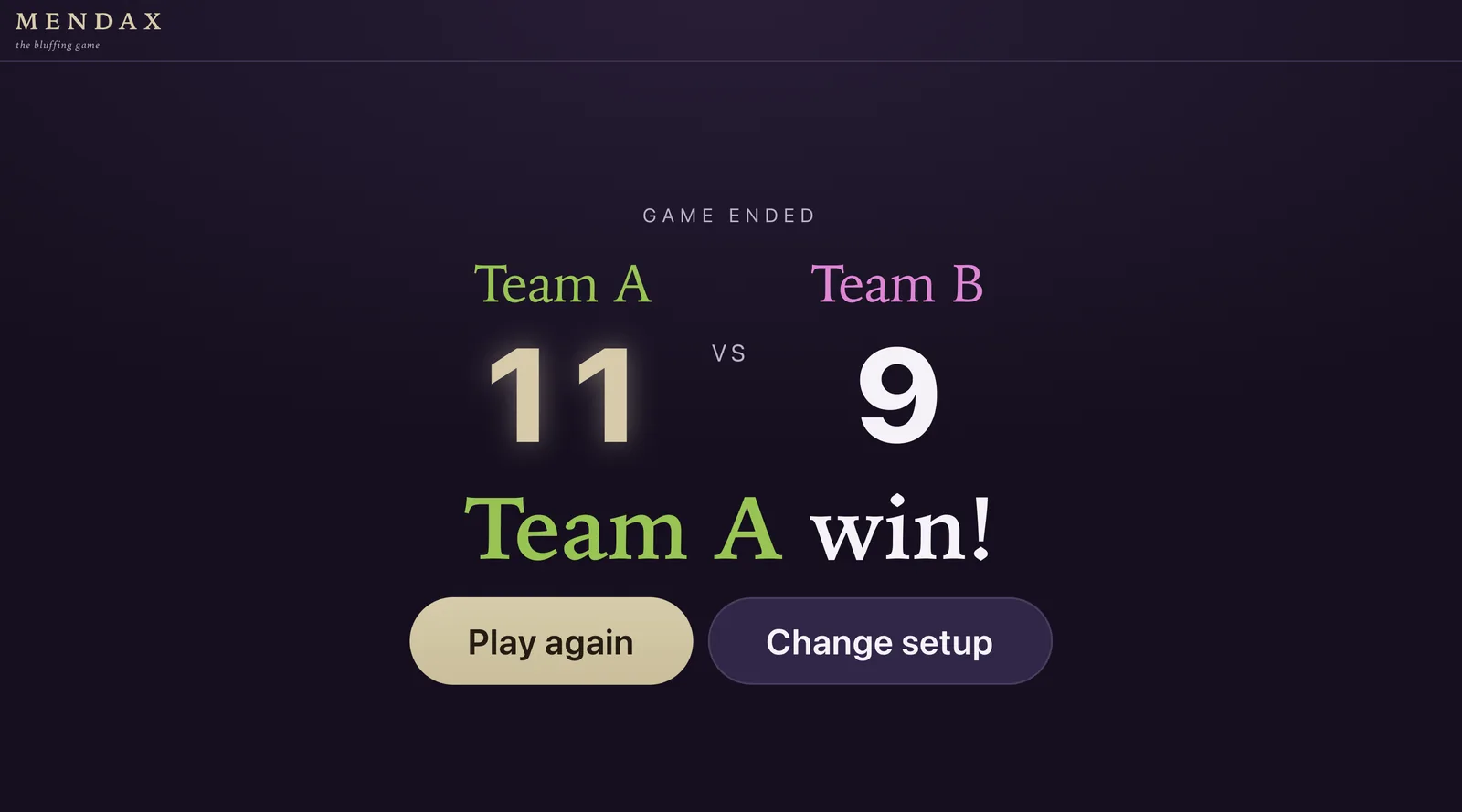
- Endings are fair. When time or the points target runs out, the round in play finishes. If one team has had fewer turns, the screen announces a LAST QUESTION so both teams end with the same number of turns.
- Reloads are safe. If the browser closes or the laptop sleeps, opening MENDAX again offers to resume the game where it stopped, clock and all.
Bring Your Own Questions
MENDAX comes with a ready-made Latin pack on the gods and goddesses (deī et deae), but you can write a pack for any language or subject in minutes: this week's vocabulary, the periodic table, the causes of the First World War, tomorrow's quiz. A question pack is a plain-text file: the first line is the title, and every line after that is one question. Add a vertical bar and the answer if you want it shown after the round.
Mendax: deī/deae
quis est pater Mārtis? | Iuppiter
quod animal est Iūnōnis? | pāvō
Mendax: Chemistry review
What is the chemical symbol for sodium? | Na
How many protons does a carbon atom have? | 6
Open or paste your pack on the setup screen. It stays in your browser and is never uploaded.
Tips from the Classroom
- Mix easy and hard questions so that students who are shaky can stand confidently sometimes.
- True/false, either/or, and fill-in-the-blank prompts work well and keep the pace up.
- It makes a good end-of-class activity: play for five minutes or twenty-five, whatever the bell allows.
- Watch who stands and who doesn't. It is a quick, honest read of who has the material and who needs more input.
MENDAX is free for teachers and students, with no ads, no accounts, and no personal information collected. It is based on Bluff as described by Señora Chase in “Bluff (aka my new favorite game)”. MENDAX by The Pericles Group is licensed under CC BY-NC-SA 4.0.